
She Wanted to Become a Midwife. Then Her Desk Was Empty.
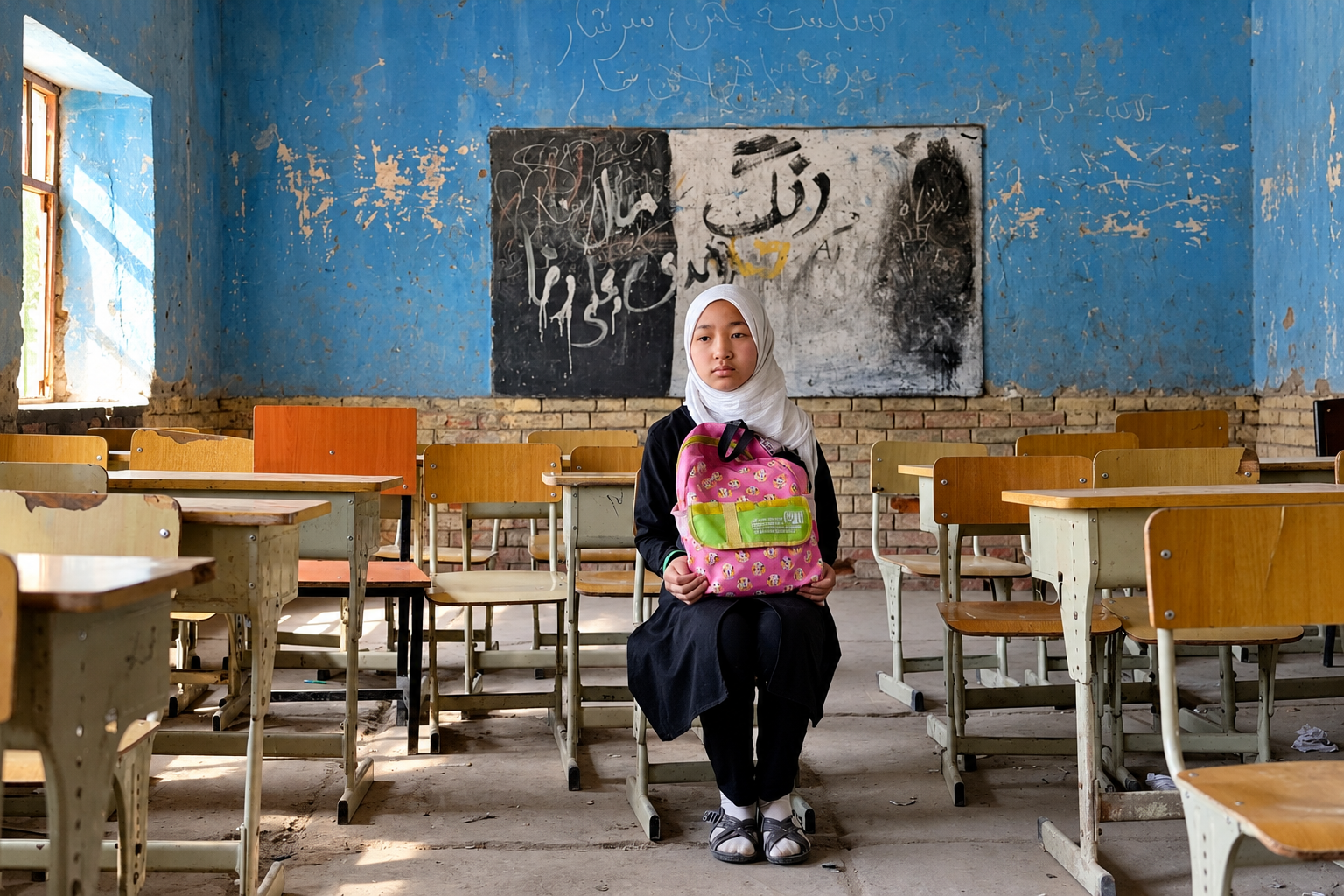
A teacher’s account of watching Afghan girls hold on to dreams that are becoming harder to reach
By Banoo Foundation
Afghanistan — The first thing I notice when I enter my classroom is no longer who is there. It is who is missing.
There are only a few rows of desks, a blackboard and a window that lets the morning light into the room. The girls arrive carrying notebooks and pens. Some whisper to one another before class begins. Others sit quietly, waiting for me to start.
From the outside, there is nothing extraordinary about this classroom.
But almost every girl sitting in front of me is carrying a question much bigger than the lesson I am about to teach: How long will I be able to continue?
I am their teacher, but I do not know how to answer them.
A dream written in a notebook
Several months ago, I gave my students a simple assignment.
“Write about your future,” I told them. “What do you want to become?”
For a few minutes, the room changed.
One girl wanted to become a doctor. Another imagined herself as a teacher. One wanted to become a journalist.
A quiet student wrote that she wanted to become a midwife.
When I asked why, she told me that women in her community often struggled to receive proper medical care. If she could continue studying, she said, perhaps one day she could help them.
She spoke with the certainty children have before the world teaches them to lower their expectations.
A few weeks later, her desk was empty.
I assumed she was sick. The following day, she was absent again. On the third day, I asked one of the other girls whether she knew what had happened.
“She is engaged, teacher,” she told me. “She won’t come anymore.”
There was nothing more to say.
I looked at her empty desk and remembered the girl who had sat there only weeks earlier, writing about becoming a midwife.
Her dream had not disappeared because she lacked ambition. She had simply lost the opportunity to pursue it.
When absence becomes permanent
Teachers everywhere take attendance. We call a student’s name and mark whether they are present or absent.
Here, an absence can mean something very different.
Sometimes a family can no longer afford the costs associated with a girl’s education. Sometimes she is needed at home. Sometimes marriage changes her life before she has had the chance to decide what she wants from it. And sometimes we never receive an explanation.
A girl simply stops coming.
The cruelest part of being a teacher is that the classroom does not stop with her.
I still have to erase the board. I still have to open the textbook. I still have to teach.
But there is an empty desk in front of me, and I know there was once a girl sitting there who had plans for her life.
“Why should we keep studying?”
One day, another student raised her hand.
“Teacher,” she asked, “if we cannot continue our education, why should we study?”
The classroom became silent.
There are questions teachers are trained to answer. This was not one of them.
I could have told her that education would change her life. I could have said that if she worked hard enough, she could become anything she wanted. But I could not lie to her.
I have watched intelligent girls work hard and still see opportunities disappear for reasons beyond their control.
So I told her the only thing I could.
“Maybe we cannot control every door that closes outside this classroom. But while you are here, do not let anyone close your mind.”
She looked down at her notebook. Then we continued the lesson.
I have thought about her question many times since.
Losing the freedom to dream
Teaching has changed my understanding of poverty.
Poverty is not only about having too little money.
There is another kind of poverty that is harder to see: when a child loses the ability to imagine a different future.
Children should be allowed to dream irresponsibly.
A girl should be able to say she wants to become a doctor today and a journalist tomorrow. She should have years to discover who she is.
But many of the girls I teach are being forced to become realistic far too early.
Instead of asking, “What do I want to become?” they begin asking, “What will happen to me?”
That difference may look small on paper. Inside a classroom, it is enormous.
The notebook she kept
Some time after my student stopped attending class, I saw her again.
I asked whether she was still studying at home.
She paused.
“My notebook is still with me, teacher,” she said.
That was all.
She did not tell me she would return. She did not say she still planned to become a midwife. She only told me that she had kept her notebook.
I went home thinking about those words.
Somewhere, perhaps inside a cupboard or beneath a pile of clothes, there may still be a notebook containing the handwriting of a girl who once believed she could spend her life helping other women.
The next morning, I returned to the classroom. I looked at the students who were still there and began taking attendance.
I cannot promise these girls that every desk will remain occupied. I cannot promise them university, a profession or even the freedom to make every decision about their futures.
But while they are sitting in front of me, I can teach them. I can ask them questions. I can make them read. And I can tell them to keep writing.
Because perhaps the greatest tragedy is not only that a girl is forced to leave a classroom.
It is that, eventually, she may stop imagining that she ever belonged there.